
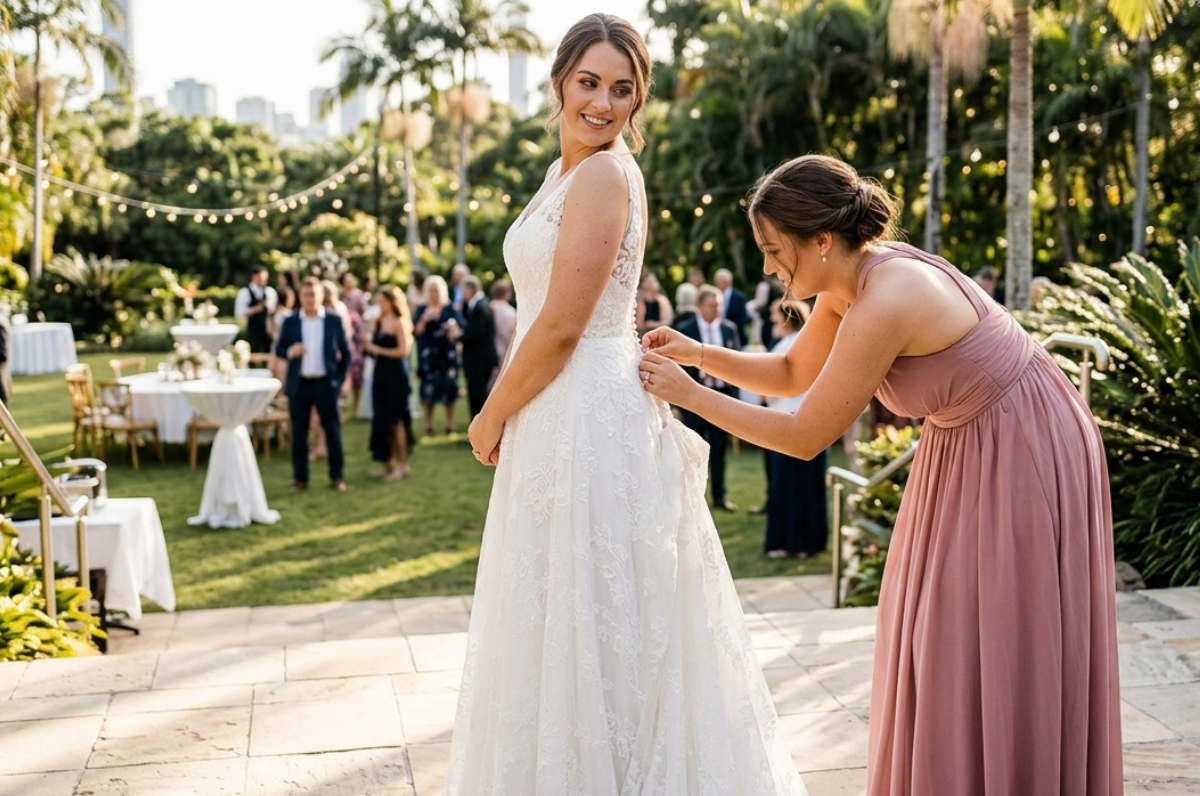
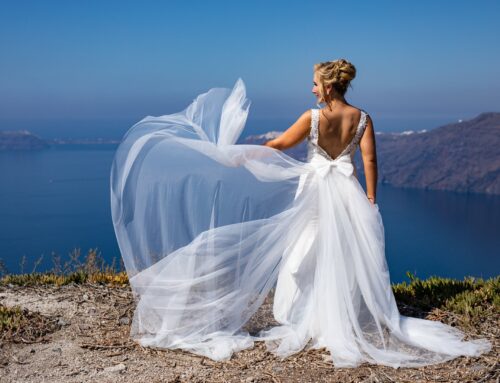
That sweeping train looks breathtaking as you walk down the aisle. But a few hours later you’ll want to mingle, sit down for dinner and dance until the end of the night. Then the train becomes something to trip over, stand on and drag through the grass.
That’s where a wedding dress bustle comes in. It’s a small piece of clever engineering that lifts your train off the ground, so your gown goes from ceremony to celebration in under five minutes.
This guide explains how a wedding dress bustle works and covers the main bustle types. It also walks through how to choose the right one, when it’s added during alterations, and how to bustle your gown step by step. There are also practical tips for Brisbane weddings, where heat, outdoor venues and lively dance floors all put a bustle to the test.
What Is a Wedding Dress Bustle and Why Does Your Gown Need One?
A wedding dress bustle is a system of hooks, buttons, loops or ties sewn into your gown. It gathers the train and secures it at the back of the skirt. Once fastened, the train is lifted to roughly floor length, so you can move freely without carrying it.
Most gowns don’t come with a bustle already fitted. Designers make each gown for many different brides, and the right bustle points depend on your height, your hem length and how the fabric falls on you. That’s why a bustle is usually added during your bridal alterations.
Why a bustle matters:
- Safety. It stops you and your guests from tripping or stepping on the train.
- Freedom to move. You can dance, walk between tables and climb stairs comfortably.
- Protecting your gown. It keeps delicate fabric off dirt, grass, sand and spilled drinks.
- No more carrying. Wrist loops are fine for photos, but holding your train all night is tiring and limits what you can do with your hands.
- A second look. A well-designed bustle creates a beautiful new silhouette for the reception.
If your gown has anything more than a very short sweep train, a bustle is almost always worth it.
The Main Types of Wedding Dress Bustles Compared
There’s no single “right” bustle. Each style creates a different look and suits different fabrics and train lengths. Here are the most common options.
Over bustle (American bustle)
The train is lifted and hooked or buttoned to points on the outside of the skirt, usually at the waist or just below. It creates a soft, draped effect over the back of the dress.
- Best for: medium to long trains, lighter fabrics, A-line and ballgown styles
- Look: romantic, flowing, with visible swags of fabric
French bustle (under bustle)
The train is tucked underneath the skirt and secured with ribbon ties on the inside. The result is a layered, ruffled look, often with one to several gathered points.
- Best for: heavier fabrics such as satin, mikado and crepe, plus long or cathedral trains
- Look: full, structured and elegant from behind
Ballroom bustle
The train is tucked and secured at many points under the skirt so the hem sits evenly all the way around. From behind, it looks as though the dress never had a train.
- Best for: brides who want a clean, floor-length reception look, and gowns with lots of skirt fabric
- Look: seamless and polished
Austrian (waterfall) bustle
A ribbon or cord runs vertically through loops inside the skirt. When pulled, it gathers the train upward into soft, cascading ruffles.
- Best for: lightweight fabrics like chiffon, organza and tulle
- Look: theatrical, layered and soft
Single-point bustle
The train is lifted to one point at the centre back and secured with a hook or button.
- Best for: short to chapel-length trains and lightweight gowns
- Look: simple and quick to fasten
Detachable train
Rather than bustling, the train is removed completely after the ceremony. It’s a good option for gowns with very long or separate overlay trains.
- Best for: brides who want two completely different looks
- Look: streamlined reception silhouette
At a glance:
| Bustle type | Fastening | Train length | Fabric weight | Reception look |
|---|---|---|---|---|
| Over (American) | Hooks or buttons, outside | Medium to long | Light to medium | Soft drape |
| French (under) | Ribbon ties, inside | Long to cathedral | Medium to heavy | Ruffled, full |
| Ballroom | Multiple ties, inside | Any | Any | Even hemline |
| Austrian | Drawstring cord | Short to medium | Lightweight | Cascading ruffles |
| Single-point | One hook or button | Short | Lightweight | Simple lift |
| Detachable train | Snaps, hooks or buttons | Any | Any | Train removed |
How to Choose the Right Bustle for Your Gown, Fabric and Train
Choosing a bustle is a mix of practicality and personal style. Consider these factors before your fitting.
Train length
A short sweep train may only need one or two points. A cathedral train usually needs five or more points to spread the weight evenly.
Fabric weight
Heavy fabrics can pull on outside hooks and leave the bustle drooping by mid-evening. Under bustles with ribbon ties usually hold them better. Lightweight fabrics suit over bustles and Austrian styles, which show off their movement.
Lace and embellishment
Lace and beaded trains are often best bustled so the detail stays on show. A skilled seamstress will place each point so it sits within the pattern, which hides hooks and stitching.
Gown silhouette
- Ballgowns suit French and ballroom bustles, which keep the full shape.
- A-line gowns work with most styles.
- Fit-and-flare and mermaid gowns often suit French bustles, which balance the fitted top with a fuller lower back.
- Sheath and slip dresses usually need a simple single-point or minimal over bustle.
Your reception plans
If you plan to dance most of the night, choose a secure style with several points. If you’d love photos showing a dramatic second look, a French or Austrian bustle gives extra impact.
Tip: Bring photos of reception looks you love to your consultation. Your seamstress can tell you which bustles will achieve that look on your particular gown.
When Your Bustle Is Added During the Bridal Alterations Process
The bustle usually comes near the end of the alterations process. It depends on your final hem length, so the hem has to be set first.
A typical sequence looks like this:
- Initial consultation. You discuss your gown, your venue and the style of bustle you’d like.
- First fitting. The fit is pinned and the hem marked with your wedding shoes on. The bustle style is often agreed here.
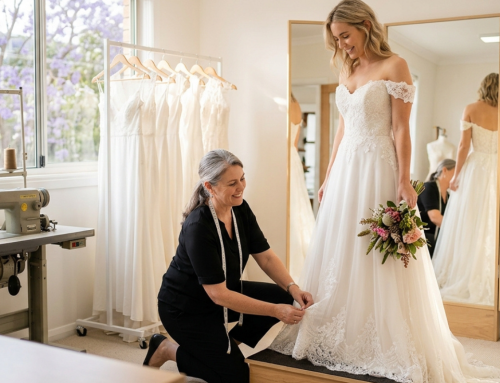
- Second fitting. Once the hem and fit are complete, the bustle points are pinned while you stand in the gown. The seamstress lifts the train, checks the drape from every angle and marks the attachment points.
- Final fitting. The bustle is sewn in. You and your helper practise fastening it, and you walk, sit and move around to make sure it holds.
Why your shoes matter: The bustle is set so the train lifts to just above the floor. Wearing a different heel height on the day can leave the bustled hem dragging or sitting too high. Always bring your actual wedding shoes to fittings.
How to Bustle a Wedding Dress, Step by Step
Every gown is slightly different, but the basic process is similar for most bustles. Your seamstress will show you the exact steps for your dress at your final fitting.
Before you start
- Choose a clean, flat spot with a little room to move.
- Stand still and straight, with your weight evenly balanced.
- Your helper should have clean, dry hands.
For an over bustle (hooks or buttons on the outside)
- Find the loops or hooks on the train, usually marked with small thread or ribbon tags.
- Find the matching hooks or buttons near the waist or upper skirt.
- Start with the centre point. It carries the most weight and anchors the rest.
- Lift the centre loop and fasten it to the centre hook.
- Work outward, fastening the points on alternate sides so the train stays balanced.
- Step back and check the drape from behind. Smooth any folds that look uneven.
For a French or ballroom bustle (ties underneath)
- Gently lift the hem of the skirt to reveal the lining.
- Find the ribbon ties. They’re often colour-coded or numbered in pairs.
- Match each pair, such as pink to pink or 1 to 1.
- Tie each pair in a firm bow or double knot, again starting at the centre.
- Work outward, keeping the layers even.
- Let the skirt fall and check the hem sits evenly at floor height.
Final checks
- Walk a few steps to make sure nothing drags.
- Turn slowly so your helper can check from all sides.
- Make sure no ties or hooks are visible unless that’s part of the design.
Tip: Take a short video of your seamstress demonstrating the bustle at your final fitting. It’s an easy reference for your helper on the day.
Who Should Learn to Bustle Your Dress on the Day?
You can’t bustle your own gown, because the attachment points are behind you. Choose one or two people to take on the job.
Good choices include:
- Your maid of honour or a bridesmaid
- Your mum or another close family member
- A friend who’s calm, practical and good with fiddly tasks
- Your wedding planner or venue coordinator, if they’ve agreed in advance
What your bustle helper needs to do:
- Attend your final fitting so they learn the bustle hands-on
- Practise at least once or twice before the wedding
- Know where to find you after the ceremony and photos
- Know where the bustle points are and how they’re marked
- Have a quick-reference photo or video on their phone
It’s smart to train a backup too. On a busy wedding day, your main helper may be pulled into speeches or photos at the wrong moment.
Bustling for Brisbane Weddings: Outdoor Venues, Heat and a Full Dance Floor
Brisbane weddings put a bustle through its paces. Warm weather, outdoor venues and enthusiastic dancing all affect how your bustle performs.
Outdoor ceremonies
Garden, rooftop, hinterland and riverside venues are hugely popular in South East Queensland. Grass, gravel, sand and dew can mark a train quickly. Bustling straight after the ceremony and formal photos protects the fabric for the rest of the night.
Heat and humidity
On warm, humid days, delicate fabrics soften and can drape more heavily. Extra bustle points help spread the weight and stop the train sagging. Your seamstress may also suggest a lighter-weight lining or fewer layers to keep you cool.
Venue movement
Many Brisbane venues involve stairs, ramps, ferries, pontoons or moving between an outdoor ceremony and an indoor reception. A secure bustle lets you move safely without anyone carrying your train.
A full dance floor
Dancing puts the most strain on a bustle. Spins, jumps and guests stepping close can pull a single hook loose. If dancing is a big part of your night, ask for:
- Reinforced attachment points
- More points, spread evenly across the train
- Under bustles with firm ribbon ties, which are generally more secure than a single outside hook
Wet-weather backup
Spring and summer storms are common in Brisbane. If an outdoor ceremony moves indoors at short notice, you may need to bustle earlier than planned. Make sure your helper is ready to go at any time.
Common Bustle Problems and How to Avoid Them
Most bustle issues are easy to prevent with good planning.
The bustle breaks during the reception
Cause: Too few points carrying a heavy train, or attachments not reinforced.
Prevention: Ask for enough points to spread the weight, and test the bustle by walking and moving at your final fitting.
Nobody knows how to fasten it
Cause: The helper missed the final fitting or forgot the steps.
Prevention: Bring your helper to the final fitting, film the demonstration and practise before the day.
The bustled hem drags or sits too high
Cause: A change of shoes after the bustle was set.
Prevention: Wear your actual wedding shoes to every fitting, and don’t change them afterwards.
The bustle looks uneven or lumpy
Cause: Points fastened in the wrong order or ties mismatched.
Prevention: Use colour-coded or numbered ties, and always start from the centre and work outward.
Hooks or stitching are visible
Cause: Attachment points placed without considering lace or beading.
Prevention: Choose a bridal specialist who hides points within the pattern of the fabric.
The train gets damaged before bustling
Cause: Long outdoor photo sessions on grass or sand.
Prevention: Plan photos on paths or cleaner surfaces, and bustle as soon as formal photos finish.
What Affects the Cost of a Wedding Dress Bustle in Brisbane
Bustle pricing varies from gown to gown. A consultation is the best way to get an accurate quote. These are the factors that make the biggest difference:
- Number of points. A single-point bustle takes far less time than a seven-point French bustle.
- Bustle style. Ballroom and Austrian bustles involve more construction than a simple over bustle.
- Fabric. Lace, silk, chiffon and tulle need more careful handling than satin or crepe.
- Beading and embellishment. Points may need to be worked around or under detailed areas.
- Number of layers. Each layer of the skirt may need to be secured separately.
- Timing. Rush alterations close to your wedding date may cost more.
Often the bustle is done alongside other alterations, such as the hem. Ask for an itemised estimate so you can see exactly what’s included. And ask whether any follow-up adjustments to the bustle after your final fitting are covered.
Getting Your Bustle Right with a Brisbane Bridal Alterations Specialist
A wedding dress bustle is a small detail that makes a big difference to how you feel at your reception. To recap:
- A bustle lifts your train so you can move, mingle and dance safely.
- Over, French, ballroom, Austrian, single-point and detachable trains each suit different gowns and looks.
- The right bustle depends on your train length, fabric, silhouette and reception plans.
- The bustle is set after your hem, so bring your wedding shoes to every fitting.
- Choose and train a bustle helper, plus a backup.
- For Brisbane weddings, plan for outdoor venues, warm weather and a busy dance floor.
At Tatjana Alterations, we’ve created bustles for every style of gown. That includes light boho dresses, lace mermaid gowns and full designer ballgowns with cathedral trains. We place every point with care so your bustle is secure, discreet and beautiful. At your final fitting we’ll show you and your helper exactly how to fasten it.
We offer free initial consultations, transparent pricing and flexible after-hours and weekend appointments for busy Brisbane brides.
Book your free bridal consultation with Tatjana Alterations today, and enjoy every moment of your reception in a gown that moves with you.


Leave a Reply